



Evaluate construction jobs by recurring scope, decision authority, technical judgment, and accountability. In a software demo, score two jobs with the same title, resolve a disputed rating, and recover the prior grade after approval.
Two superintendents can share a title while doing materially different work. One runs a single site and escalates staffing exceptions. The other reallocates crews across several sites and supervises site leaders. Compare their delegated authority and recurring responsibilities before assigning a grade. The O*NET construction manager profile illustrates how broadly these titles are used. The BLS cost estimator profile provides a separate reference for work such as evaluating labor, materials, and schedule assumptions.
What should construction job evaluation measure?
Construction job evaluation uses consistent criteria to assess the internal demands of a role. Start with approved job descriptions, then collect evidence from project organization charts, delegation schedules, staffing approvals, and escalation procedures. Use your job architecture to compare jobs across field operations, project delivery, estimating, and office teams. A point-factor method assigns a degree to each defined factor. The degree needs a specific example of what the job routinely requires.
When comparing job evaluation methods, ask how each defines and distinguishes adjacent degrees. Mercer IPE, for example, publishes its own evaluation factors. For your demo, use a common role packet so each vendor can explain how its method handles the same construction responsibilities. The generic job evaluation software buying guide covers platform questions beyond this industry checklist.
Assess the job, not the incumbent. A long-tenured superintendent may perform at a high level without the position itself having broader decision rights. Individual performance, current pay, and job title should not substitute for evidence of recurring role requirements. The O*NET construction manager profile is an occupation-level reference, not an employer-specific grading standard.
Construction job leveling criteria by factor
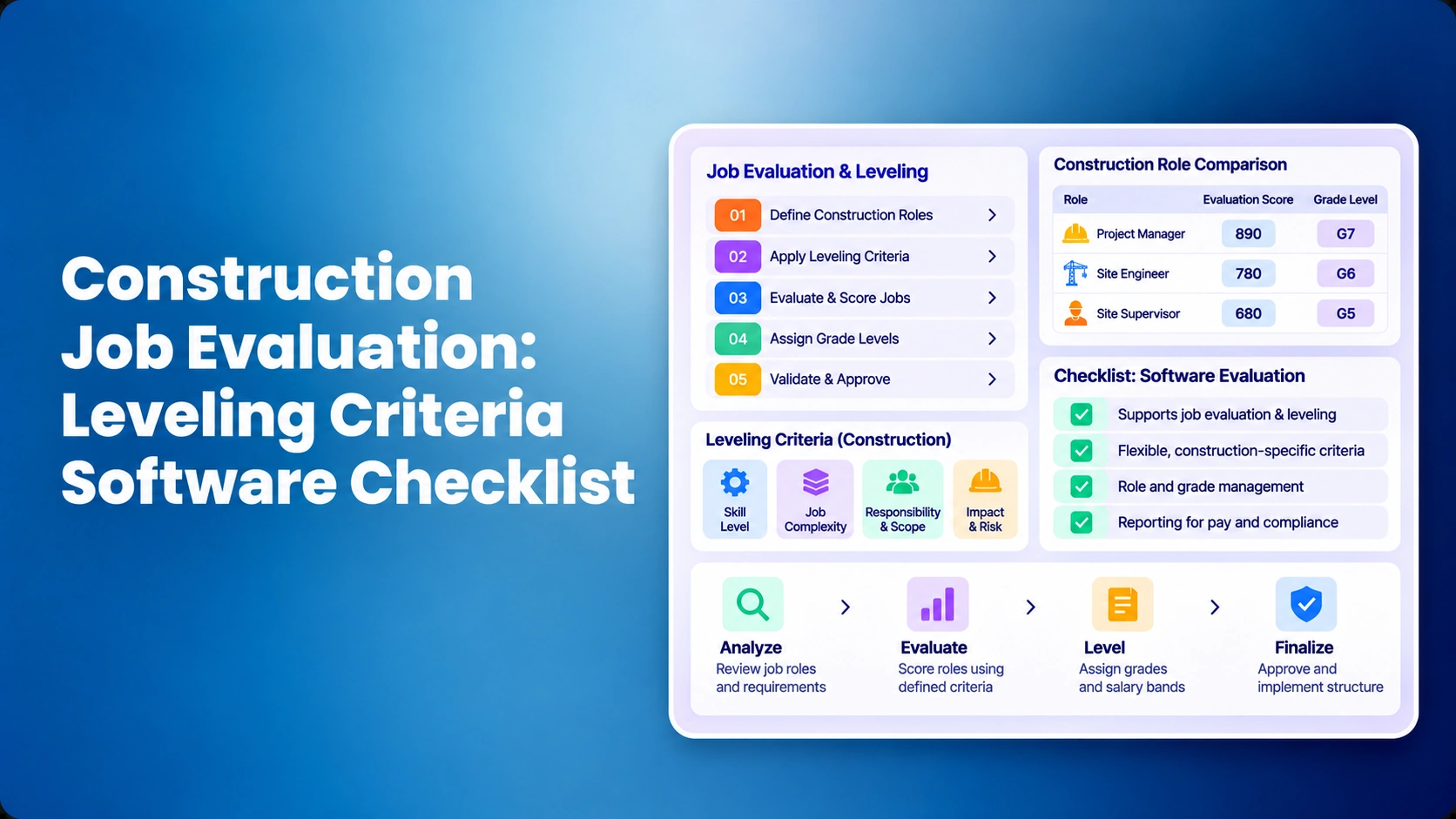
Use the matrix to collect evidence before scoring. The examples illustrate adjacent responsibilities. These six construction-focused criteria are buyer calibration prompts, not the 15 JESAP® compensable factors. Apply the factor definitions, degree weights, and grade boundaries your organization approves.
| Factor | Evidence for a lower scope | Evidence for a higher scope | Calibration risk |
|---|---|---|---|
| Decision authority | Escalates schedule and cost exceptions | Authorizes defined corrective actions | Confusing discretion with seniority |
| Project complexity | Routine single-site assignments | Multiple interdependent, technically complex projects | Using contract dollar value alone |
| People responsibility | Coordinates peers and subcontractors | Formal staffing, performance and workforce decisions | Counting contractors as direct reports |
| Financial accountability | Monitors assigned cost categories | Owns portfolio-level budget decisions | Equating spend visibility with approval power |
| Technical judgment | Applies established methods | Resolves novel engineering or execution problems | Overvaluing certifications not used in the role |
| Safety accountability | Reports hazards and escalates exceptions | Owns corrective action across sites and verifies closure | Counting project hazards twice under complexity and accountability |
How should HR calibrate construction job factors?
- Lock the evidence: collect the approved job description, organization chart, reporting lines, delegation limits, and recurring project responsibilities.
- Score independently: ask HR and operations to evaluate the same role using approved degree definitions before comparing answers.
- Challenge disagreements: require a concrete decision right, ongoing accountability, or technical requirement to support a higher degree, not a senior title or higher salary.
- Prevent double counting: distinguish project complexity from financial authority and safety accountability when the same incident is used as evidence.
- Approve and version: preserve initial ratings, objections, final rationale, approver, and effective date before reviewing compensation.
Use the organization's actual factor weights and approved grade thresholds. This checklist standardizes evidence collection; it does not create a universal points-to-grade conversion.
Worked example with two superintendents
In this fictional case, the first superintendent coordinates subcontractors on one commercial site and sends staffing changes to operations for approval. The second moves crews between active sites, assigns work to site leads, and can approve changes within delegated limits. That evidence may support a higher degree for decision authority and supervision. A higher rating for financial accountability requires separate evidence of budget authority.
Suppose the second superintendent only covered the additional sites for six weeks. Record the dates, check the approved duties, and determine whether the broader scope is now recurring. If it was temporary, send it through the assignment-pay policy for review and retain the current evaluation unless the job itself changed. Use the job leveling framework to distinguish career progression from a short-term assignment, and check how grades and levels map in your organization.
Repeat the comparison with a senior estimator and a project manager. The estimator may own bid assumptions and review complex takeoffs while the project manager approves change-order recommendations and owns cost forecasts. Calibrate each factor against its evidence. This gives technical specialists room to advance without requiring people-management duties.
Test Two Superintendent Roles in CompBldr
Bring anonymized job descriptions and a disputed factor rating. Ask to see how CompBldr records the factor scores and compares evaluation versions.
Book a DemoIllustrative decision record: same title, different responsibility
Superintendent A: manages one site, coordinates subcontractors, proposes schedule changes, and escalates crew reallocations. Superintendent B: holds recurring responsibility for several sites and can reallocate staff within written delegation limits. Document the clause and effective date that support B's broader decision authority. Do not increase the financial-accountability rating without separate evidence of budget approval authority.
Temporary-duty control: if B is covering multiple sites during a short absence, document the assignment dates and policy owner. Review whether the job changed permanently before approving a new grade. Any temporary assignment premium is a separate pay decision.
Construction job evaluation software checklist
Give each finalist the same approved role descriptions and delegation records. Ask HR and operations to score independently before the demo, then use the checks below to see whether the software can explain and preserve a disputed decision.
What should every vendor receive before the demo?
Provide a consistent, permission-cleared evidence pack: two anonymized superintendent job descriptions; an organization chart; written delegation rules; approved factor definitions and grade boundaries; one disputed factor rating; and an earlier evaluation to reconstruct. Add one senior estimator to test a technical career path that does not depend on direct reports. Ask the vendor to demonstrate the stored decision history and the export HR or Finance would actually retain. If a workflow requires external approvals or attachments, have the vendor identify and show that integration or manual control.
| Evaluation | Expected evidence | Warning sign |
|---|---|---|
| Factor definitions | Scope, supervision, autonomy and impact | Opaque vendor grade |
| Reviewer control | Disagreement, evidence and authorization | No override trail |
| Career architecture | Progression within job family | Grade inflated for every title |
| Downstream effect | Market, range and decision history | Automatic salary revision |
- Start with the approved role. Show the description, its version, and the degree definitions visible to the evaluator. If a role spans multiple projects, show how the evaluator records what the person actually owns.
- Resolve a disagreement. Have one reviewer rate decision authority higher than another. Give both reviewers the approved delegation record and ask each to cite the decision right that supports their rating. After the authorized reviewer finalizes the grade, have both reviewers independently retrieve the delegation record, the original and final factor degrees, and the reason for the final decision. Mark the test as passed when both can reconstruct the decision from the saved record. Use the point-factor demo tests to check which evidence the platform retains.
- Reconstruct a prior decision. Save a revised evaluation with an effective date. Ask another reviewer to recover both sets of ratings and explain what changed. Inspect the available reporting outputs and confirm which records can be exported.
- Review the pay handoff. Show the approved grade, applicable range, and proposed employee impact as distinct records. Ask who authorizes any pay change and how range version history preserves the earlier decision.
Mark each test pass when the finalist demonstrates it with your roles and gives you a record to review. Use partial for a documented workaround. If a test fails because the prior grade cannot be recovered or a change bypasses approval, ask for a second demonstration before signing off.
How should buyers score the four software checks?
Score each checklist area on a 0–2 scale: 2 if the vendor completes the task and shows a reproducible record using the sample role evidence; 1 for a demonstrated workaround or stated configuration dependency; and 0 if the task cannot be demonstrated. The maximum is 8 points. Record the outcome, prerequisites, and evidence retained. This is a suggested buyer scorecard, not a published CompBldr performance score.
Mandatory gates: the system must explain factor degrees, retrieve a previous evaluation, identify the decision-maker and reviewer, and keep a grade proposal separate from an approved pay change. A high total score does not resolve failure on a mandatory control. Use the same pack with every finalist.
How approved grades feed into pay decisions
Calibrate internal grades before reviewing incumbent salaries or market rates. Then use market benchmarking to assess external pay for the role and construction market-pricing vendor tests to compare survey matches across recruiting markets. One internal job can have different external pay references across locations.
Compare the approved grade with the salary structure and have Finance review costs and timing through compensation planning. Assign an owner for the job record and an approver for any pay action. Check project-specific wage obligations separately with the U.S. Department of Labor’s Davis-Bacon guidance and qualified advisers.
A job grade is not a legal wage classification. A construction job-evaluation result does not establish whether Davis-Bacon prevailing-wage or certified-payroll obligations apply. On covered projects, review applicable wage determinations and actual duties: a supervisory title alone does not resolve every classification issue. The U.S. Department of Labor DBRA FAQs address covered workers and supervisors performing some manual duties. Confirm project-specific requirements with the contracting agency or qualified counsel.
What to verify in a CompBldr demo
CompBldr's job evaluation workflow documents the JESAP® 15-factor methodology, including factor degree definitions, proposed grades, evaluator identity, timestamps, and version comparisons. Public product information also describes algorithm-based calibration as a review aid rather than a substitute for human judgment. These are documented product descriptions, not guarantees about a particular configuration.
In the demo, score the same two superintendent jobs, show a disputed factor rating, and compare the earlier and revised saved evaluations. Trace the reviewed grade into the construction compensation workflow. Ask the product team to demonstrate reviewer permissions, final authorization, export formats, configuration prerequisites, and how an organization's current methodology could be handled. A saved score should not be mistaken for an approved pay action.
Review a Contested Grade Decision
Walk through a changed factor rating, its approval record, and the proposed salary-range impact with the CompBldr team.
Book a DemoSources and methodology (reviewed November 14, 2026): O*NET and the Bureau of Labor Statistics provide occupation-level duties; Mercer IPE and CompBldr describe distinct job-evaluation methods. The six-criterion construction matrix, two-superintendent example, and eight-point buyer rubric are illustrative evaluation tools, not validated compensation grade standards. Verify product requirements in a live demonstration. This content is not legal advice.